

As a business leader, your mission to deliver an exceptional customer experience (CX) grows more challenging by the day. In the dynamic arena of competitive markets, the advent of customer journey mapping in CRM has become a cornerstone of successful CRM strategies. This systematic approach grants you the prowess to analyze and perfect every interaction, transforming data into insightful customer narratives. Now, imagine having a roadmap that not only traces customer footsteps but also anticipates their needs and desires—this is the power of CRM customer journey mapping.
By investing in this capability, you place yourself at the vanguard of customer engagement, ready to tailor unique experiences that resonate with your audience. The understanding gleaned from customer journey mapping equips you to enhance touchpoints across the entire lifecycle of your customer relations, thereby deeply embedding customer satisfaction into the fabric of your business’s DNA.
Key Takeaways
- Seize the strategic edge with customer journey mapping in CRM, defining a clear path to CX excellence.
- Discover how CRM customer journey mapping fortifies customer relationships by providing actionable insights.
- Realize the benefits of a refined CRM strategy, which leads to improved customer retention and loyalty.
- Embrace the infusion of customer insights into your business’s pulse, ensuring every decision is customer-centric.
- Understand that a well-executed journey map magnifies the quality and effectiveness of customer engagements.
- Learn that personalizing customer experiences is not just an art but a measurable, data-driven science.
Understanding Customer Journey Mapping
As you delve into the world of CRM, it’s crucial to recognize the transformative power of a meticulous customer journey mapping strategy. This intricate tapestry weaves together the countless interactions and experiences your customers face throughout their connection with your brand. Let’s glean a deeper understanding of this essential tool, which can redefine the prism through which you view your business operations and client engagement.
Defining Customer Journey Mapping in CRM
At its core, customer journey mapping within a CRM framework serves as a blueprint for the path your customers walk—from initial awareness to potential post-purchase advocacy. It is a systematic visualization that encapsulates each step a customer takes, backed by an arsenal of CRM tools. By deploying this strategy, you can demystify the customer behaviors often hidden behind raw data, turning them into relatable human experiences. Such insights invariably steer the development of more impactful interactions that resonate with your audience, placing the customer narrative at the forefront of your CRM journey mapping process.

The Importance of a Customer-Centric Approach
Adopting a customer-centric approach is not merely an ideal but an imperative strategy in today’s market. Your CRM’s ability to champion this perspective is paramount to your success. Customer journey mapping makes this possible, illuminating the emotional landscape that governs customer decisions and satisfaction. It is a strategic compass that guides your CRM initiatives, ensuring that every touchpoint elegantly aligns with your customers’ aspirations and addresses their needs proactively.
Fostering Empathetic Insights into Customer Behaviors
Empathy is the catalyst for genuine connection, particularly in deciphering the outward manifestations of customer behaviors. Through customer journey mapping, you amplify your capacity for understanding by experiencing the journey as your customers do. This empathetic approach uncovers not just the what, but the why behind each customer interaction. Your CRM becomes not just a repository of customer data but a dynamic, empathetic tool, transforming every collected insight into an opportunity to deliver unprecedented value and foster robust brand loyalty.
Every stage of the journey mapping process holds the promise to unveil strategic insights, granting you a comprehensive outlook on where your business stands and guiding where it should aim. By integrating these practices into your CRM, you ready your company for a future where customer experience is not a siloed effort but an integrated mission—your roadmap to unparalleled customer delight.
The Strategic Role of CRM in Customer Journey Mapping
Setting the stage for your customers’ journey, your CRM platform becomes the foundation for designing their experience with precision and finesse. It’s here that the intricacy of CRM customer journey mapping begins to unfold, revealing opportunities for personalization and sustained engagement. Adjust your strategies in CRM and watch as they align with the rhythm of your customer’s journey, issuing a symphony of memorable experiences and interactions.
Aligning CRM Strategies with the Customer Journey
Imagine your CRM as the compass that navigates the complex waters of customer interactions. By clearly defining the CRM journey mapping process, you’re able to chart the course for every stage of the journey, ensuring a persistent alignment with your business’s strategic objectives. This precise synchronization of CRM with the customer journey empowers you to cater to the dynamic needs of your target audience, fostering a connection that transcends the conventional.
CRM as a Tool for Personalization and Engagement
A CRM is not just a tool for managing customer interactions but a gateway to their hearts. Through diligent CRM data analysis, embrace the art of personalization in CRM, shaping experiences that feel singularly tailored to each individual’s preferences. Cultivate deeper ties with your customers by harnessing customer engagement frameworks, transforming routine transactions into personal relationships. The wisdom gained through CRM analytics enables you to draw your customers closer to your brand through a series of impactful, meaningful experiences.
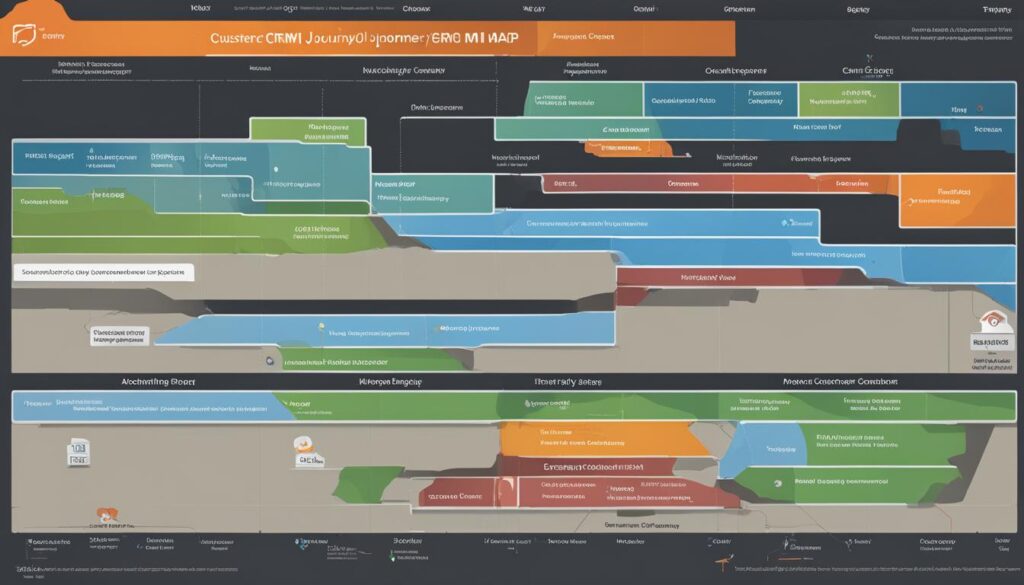
Your CRM isn’t merely a system; it’s the fertile soil where customer loyalty grows. In the realm of modern business, set your customer at the center of your universe with a CRM designed to delight, engage, and retain. Master the journey, and you command the goal: a thriving relationship where both customers and businesses achieve their grandest aspirations.
Identifying Touchpoints and Defining Stages
Embarking on CRM customer experience mapping begins with the critical step of identifying customer touchpoints. You’ll uncover every instance where customers encounter your brand, from navigating the company website to engaging with social media. These touchpoints are the milestones of the customer journey, providing you with a canvas to paint a detailed picture of the customer experience. It’s akin to plotting points on a map—each one holds the potential to either propel the journey forward or detract from it. Your meticulous attention to these moments can transform a mundane interaction into an opportunity for engagement.

Next, you’re tasked with defining customer journey stages—it’s essential to carve these out to understand the progression from one point to another. Stages such as awareness, consideration, purchase, and retention are milestones in the customer lifecycle. They are segments that customers pass through, each with distinct expectations and opportunities for your brand to make an indelible mark. Recognizing and refining these stages empowers your company to navigate and optimize the customer experience with precision.
- Awareness: The introductory phase where your brand first captures the customer’s attention.
- Consideration: This is when customers are evaluating their options, often comparing your offerings with competitors.
- Purchase: The critical conversion point where browsing leads to buying.
- Retention: The post-purchase phase focusing on nurturing customer relationships to encourage loyalty.
By understanding these touchpoints and journey stages through an analytical CRM lens, you position your business to anticipate needs and customize responses to any arising challenges. This proactive approach enables you to address pinch points—the hurdles that could thwart an otherwise smooth customer journey. Through identifying customer touchpoints and defining customer journey stages, you empower your CRM system to operate not just as a database, but as an engine for sustained customer delight.
Customer Journey Empathy: Walking in Their Shoes
Mastering the art of customer journey empathy is akin to slipping into your customers’ very own shoes, offering a perspective that goes beyond mere observation to genuinely understand their experiences. The pursuit of empathetic customer insights is not just beneficial; it’s imperative in crafting a brand experience that resonates deeply and positively with customers. By utilizing advanced CRM journey mapping techniques, you gain the aptitude to delve into the emotional aspects of your customers’ paths—a critical element in developing lasting customer relationships.
Imagine looking at your brand through the lens of your customers, feeling their triumphs and their frustrations as if they were your own. This is where true connection begins, and this is what empowers you to elevate your customer’s experience from the ordinary to the extraordinary.

A focus on the emotional journey not only elucidates the rational steps customers take but also illuminates their decision-making process. Emotions are a driving force behind customer loyalty and advocacy. As you assimilate the nuances of customer journey empathy, you’ll be equipped to identify key elements that can transform the customer experience:
- The first smile: Discover what brings joy in the initial stages of interaction.
- The moment of truth: Identify the pivotal points that can make or break trust.
- The sigh of relief: Understand what solutions provide customers with peace of mind.
Embodying your customers’ journey allows you to scrutinize and refine each touchpoint along the way. It’s about perceiving not just what your customers do, but why they do it. Do they feel understood, valued, and cared for? This level of empathy yields advantages in both structuring CRM solutions and fostering authentic, positive engagements.
By prioritizing empathy in your CRM journey mapping techniques, each strategy you devise is crafted with a deeper knowledge of your customer. This approach lays a foundation for enhanced experiences that empower both your customers and your business. Walking in their shoes is not just about seeing the path; it’s about feeling the journey and using those insights to pave a way forward that is intuitively aligned with customer expectations and desires.
Data-Driven Insights: Collecting and Analyzing Customer Data
Embarking on the journey of understanding your customers requires a compass that points to the heart of their experiences. This is where leveraging data-driven insights becomes your pivotal tool. As you navigate the landscape of customer data analysis, remember that each interaction your customer has with your brand is an opportunity to collect valuable data. From these interactions, a picture begins to form, one that shows not just behavior but preferences and patterns that can inform your approach to CRM data analytics.
Gathering Customer Data Across Touchpoints
The task ahead is clear: gather customer data from all conceivable touchpoints. This could be a comment made on social media, an interaction with your email campaign, or an inquiry to your customer support team. Each touchpoint contributes to an aggregate understanding of your customer, which can be treasure troves of insights when it comes to analyzing customer behavior. The goal is to collect this information in a way that respects your customer’s privacy while still providing you with actionable insights.
Tools and Techniques for Customer Data Analysis
Once data is collected, the next imperative step is analysis. This is where robust tools and techniques come into play. Utilize CRM data analytics to sift through data, uncovering patterns and trends. It involves deploying sophisticated algorithms and analytics models that can digest large volumes of data and output transformative insights. These findings will guide you in addressing pinch points, refining the customer journey map, and ensuring that your CRM system adapts and grows with your customers.
From customer surveys that bring qualitative insights to the quantitative rigour of website analytics, your focus should be on integrating these different data streams into a cohesive whole. Only then can you claim to truly understand your customer, predict their next move, and craft an experience that feels personalized and deeply satisfying. This is the new threshold for success in the digital economy – and you now stand at its door.
Customer Journey Mapping in CRM
When you’re implementing customer journey mapping in CRM, it’s crucial to start with a strategic approach that incorporates your findings into the CRM strategy. This process not only identifies but also seeks to rectify the pain points encountered by your customers. Additionally, it aims to seize potential opportunities that emerge during the mapping phase. Getting this right ensures your CRM system remains dynamic and responsive to the ongoing changes within the customer journey landscape, significantly impacting customer satisfaction and your company’s overall performance.

By adhering to customer journey mapping best practices, you foster a system that’s not rigid but one that evolves—a win-win proposition that delivers value to both your customers and the business. Let’s delve into the steps necessary to seamlessly integrate customer journey insights into your CRM strategy:
- Gather Comprehensive Data: Start by collecting data at every customer touchpoint. This includes interactions on websites, social media, customer service encounters, and feedback mechanisms.
- Analyze the Data: Look for patterns, behaviors, and trends within the data to understand customer experiences and expectations deeper.
- Identify Customer Journey Stages: Pinpoint the different stages your customers go through, such as awareness, consideration, decision, and retention.
- Map Pain Points and Opportunities: Using the insights from your data, highlight areas needing improvement and areas where your company excels.
- Integrate Into CRM: Adjust your CRM system to address these points, tailoring engagement strategies and communications accordingly.
- Test and Refine: Implement the changes and closely monitor their impact. Use customer feedback and performance data to refine your approach continuously.
Executing these steps effectively ensures that your CRM becomes more than just a database—it evolves into a proactive tool that enhances customer experiences at every journey stage. Ultimately, CRM customer experience mapping is about fostering a symbiotic relationship where the business grows through insightful customer understanding and strategic action. By embracing these best practices, you empower your CRM to deliver personalized, timely, and contextually relevant experiences that resonate with customer expectations and drive engagement.
Crafting a Seamless Post-Purchase Experience
Your users have just completed the purchase phase, and it’s critical to continue the momentum with a robust post-purchase experience, turning new buyers into lifelong fans. It’s not just about the sale—it’s about fostering a continuing relationship. With the right customer retention strategies, you can demonstrate just how much you value them, long after they’ve checked out.
Onboarding and Customer Support Excellence
Providing stellar customer support is paramount in fostering a positive post-purchase experience. It’s essential to ensure that your customers can reach you through their preferred channels—be it email, chat, or phone. With every interaction, they must feel heard, supported, and valued. But it doesn’t stop there; a comprehensive onboarding program is necessary to guide your customers through the ins and outs of your product or service, minimizing frustration and promoting successful user adoption. Remember, a well-informed customer is a satisfied customer who’s more likely to stay with your brand.
Leveraging Feedback for Continuous Improvement
Feedback collection is critical in understanding your customers’ needs and the overall efficacy of your customer support. It’s a powerful tool that should be a staple in your after-sale process, offering invaluable insights into how you can improve. Paying close attention to your customers’ feedback allows you to iterate on your products and services, evolving to meet and exceed their expectations. By leveraging such feedback, you can implement continuous improvements that resonate deeply with your customers’ needs and desires, ensuring that your brand remains as dynamic and agile as your marketplace demands.
Whether it’s the onboarding journey, customer support encounters, or gathering and implementing feedback, excellence in the post-purchase realm is a key driver of customer loyalty. Tap into powerful retention strategies and see your brand thrive, fueled by the trust and advocacy of satisfied customers who feel supported every step of the way.
Driving Business Growth Through CRM Customer Experience Mapping
In the pursuit of business growth, leveraging the strategic benefits of CRM customer experience mapping is integral. This enlightened approach to understanding your customer’s journey can be the driving force behind sustaining and expanding your customer base. Let’s explore how utilizing CRM insights can catalyze your business growth by emphasizing customer retention and satisfaction, and offering a platform for competitive differentiation.
Improving Customer Retention and Satisfaction
Retaining customers is more cost-effective than acquiring new ones, and CRM customer satisfaction is a critical ingredient in the recipe for retention. By mapping the customer journey within your CRM, you gain the insights necessary to not only meet but exceed customer expectations. This, in turn, fosters customer satisfaction—an essential element in securing repeat business and referrals. An enhanced understanding of the customer journey assists in pinpointing and addressing the pivotal moments that either cement loyalty or lead to customer defection.
Competitive Differentiation through Enhanced Customer Journeys
CRM customer experience mapping offers more than a microscopic view of customer interactions; it provides a macroscopic lens through which competitive differentiation comes into focus. By thoroughly understanding and managing the subtleties of the customer journey, your business can stand out in a crowded marketplace. Enhanced customer journeys translate to unique brand interactions, setting your business apart and attracting new customers while maintaining a stronghold on existing ones. Such differentiation solidifies your company’s market position, paving the way for sustainable growth and profitability.
Implementing Changes: Actioning Customer Journey Insights
The true testament of effective customer journey mapping lies in the actioning of customer insights that have been revealed through CRM analysis. It’s the stage where the journey transcends from being a visual aid to a catalyst for tangible enhancements in the customer experience. This iterative process promises a dynamic evolution of CRM implementation, fostering an environment where customer satisfaction is not just a goal but an ongoing commitment.
By systematically applying the insights from your customer journey maps, you can drive impactful changes across multiple facets of your organization. These adaptations are not mere tweaks but strategic enhancements made to optimize the customer journey. Moreover, they’re designed to flex and morph in response to new customer feedback, ensuring your CRM initiatives always strike the right chord with your clientele.
You’ll find that the path to customer journey optimization is both enlightening and challenging. Yet, with dedication and agility, you can fine-tune your CRM system to reflect a deep understanding of your customer’s needs and behaviors. These insights fuel continuous improvements, amplifying the quality of every interaction, and pivoting as necessary to meet the evolving market demands.
- Analyze Customer Feedback: Start with the wealth of data and feedback that customers provide through various touchpoints. This gives you deep insights to understand their experiences.
- Identify Opportunities: Pinpoint where their journey could be smoother or more engaging and pinpoint opportunities for innovation.
- Optimize Touchpoints: Utilize data analytics to enhance the customer experience at each identified touchpoint within the CRM system.
- Refine Communications: Tailor your messaging and channels to resonate better with your customer’s preferences and pain points.
- Iterate Offerings: Continuously refine products and services to address customer needs more effectively, ensuring that your solutions remain competitive and relevant.
- Monitor Changes: Establish KPIs to measure the impact of your changes and remain vigilant to adapt swiftly based on customer feedback and behavioral shifts.
Remember, your CRM is more than just a system; it’s a reflection of your commitment to your customers. Each step you take towards CRM implementation and customer journey optimization is a step towards solidifying your relationships and driving long-standing success. It’s all about creating a harmonious synergy between customer insights and business initiatives, where each action taken is an informed stride towards excellence.
Key Challenges in Customer Journey Mapping
Embarking on customer journey mapping within CRM initiatives is a powerful strategy to enhance customer understanding and boost CRM efficacy. Yet, it is not without its set of hurdles. As you venture deeper into customer journey mapping, you’ll encounter specific challenges that can impede the path to gaining comprehensive insights. Overcoming these obstacles is vital to ensure that customer journey mapping augments your CRM capabilities and truly benefits your customers.
Overcoming Data Collection and Integration Hurdles
One of the primary challenges in customer journey mapping is the meticulous collection and integration of data across various customer touchpoints. With the vast amount of data generated, it’s crucial to ensure that your CRM system can seamlessly integrate and interpret this data to form a coherent customer journey map. This complexity becomes even more pronounced when considering the various platforms and technologies used to interact with customers, necessitating a sophisticated approach to data integration in CRM.
- Data accuracy and consistency across touchpoints
- Capturing and integrating real-time customer data
- Ensuring privacy compliance in data collection and usage
Addressing Complex Customer Journeys in Multiple Channels
Today’s customers are more connected than ever, often using a multitude of channels during their journey. Consequently, one of the significant multichannel customer journey complexities involves tracking and understanding customer behaviors across these channels. Recognizing patterns and ensuring a consistent customer experience can be quite demanding, as it requires a deep dive into customer interactions and a strong grasp of varying channel dynamics.
- Mapping customer behavior across offline and online channels
- Providing a unified customer experience in a multichannel environment
- Adjusting CRM strategies to accommodate the nuances of different channels
As you tackle these challenges, remember that the objective is to smooth out the customer journey, making every step as personalized and responsive as possible. Overcoming these hurdles not only improves the customer experience but also enhances the quality of your CRM’s data-driven insights, leading to more informed decisions and proactive engagement strategies. Commit to addressing these challenges head-on, and you’ll pave the way for a more customer-centric, successful business model.
Conclusion: Elevating the Customer Experience Through CRM Journey Mapping
Embarking on customer journey mapping in CRM is more than just adopting a new process—it’s a strategic commitment to dive deep into the world of customer insights. This meticulous exercise is a profound channel for enhancing your CRM strategy, turning every customer interaction into an opportunity for growth. The clarity gained provides a panoramic view of your customers’ worlds, allowing for precision and personalization in each engagement that directly contributes to the enhancement of the customer experience.
Your brand can shine distinctly in today’s competitive business environment by implementing customer journey mapping within CRM with dedication and sophistication. Such a customer-centric mindset not only fosters closer connections but also drives customer satisfaction and loyalty—essentials for a flourishing business. By continuously capturing and acting on relevant customer insights, you ensure your CRM strategy stays agile and receptive to the ever-changing customer landscape.
In essence, successfully leveraging these insights for customer experience enhancement signifies a pivotal transformation within your organization. It’s the path to unlocking the full potential of CRM and customer data, driving not just operational efficiency but also creating memorable customer experiences. As technology propels us forward, your dedication to customer journey mapping in CRM is what will differentiate your brand, achieving a competitive edge founded on understanding and valuing your customers at every step of their journey.
FAQ
What is customer journey mapping in CRM?
Customer journey mapping in CRM involves creating a visual representation of the entire process a customer goes through when interacting with a company, from initial awareness to post-purchase engagement. This strategic tool helps businesses to understand and analyze customer experiences across different touchpoints.
Why is a customer-centric approach important in CRM?
A customer-centric approach ensures that the strategies and activities of a business are aligned with the needs and preferences of its customers. This helps in providing personalized experiences that increase customer satisfaction, loyalty, and advocacy, ultimately contributing to business growth.
How does empathy contribute to CRM journey mapping?
Empathy allows businesses to understand and connect with the emotional responses of their customers. By viewing interactions from the customer’s perspective, companies can identify what truly matters to their audience and enhance their experience in meaningful ways.
What is the strategic role of CRM in customer journey mapping?
CRM plays a strategic role in customer journey mapping by providing the tools and analytics needed to personalize interactions and foster customer engagement. CRM systems help align business strategies with customer expectations and behaviors, leading to more nuanced and effective customer experiences.
How can businesses identify customer touchpoints?
Businesses can identify customer touchpoints by mapping out all the possible interactions a customer might have with the company, such as through websites, social media, customer service, and marketing campaigns. Recognizing these touchpoints is essential for understanding the customer journey and improving their experiences throughout it.
What techniques are used for CRM data analytics?
Techniques for CRM data analytics include the use of sophisticated software tools that collect and analyze customer data from various sources, such as surveys, website analytics, and social media interactions. These tools help businesses to gain insights into customer preferences, behaviors, and pain points that inform strategic decisions.
How do businesses implement customer journey mapping in CRM?
Implementing customer journey mapping in CRM involves integrating insights from the customer journey map into the CRM strategy. This includes addressing identified pain points, tailoring communications, and personalizing interactions based on the customer’s experiences and feedback.
Why is the post-purchase experience so important?
The post-purchase experience is crucial because it determines whether a customer feels valued after making a purchase. Excellent customer support, proper onboarding, and opportunities for feedback can lead to a higher likelihood of repeat business and transform customers into brand advocates.
How does CRM customer experience mapping drive business growth?
CRM customer experience mapping drives business growth by fostering greater customer retention and satisfaction. Insightful customer experience mapping leads to improved business efficiency, reduced costs, and new revenue streams while differentiating a company in the competitive market.
What are some common challenges in customer journey mapping?
Challenges in customer journey mapping include complexities in data collection and integration, understanding multifaceted customer journeys across various channels, and the need for organizational shifts to adopt customer-centric strategies effectively.
